
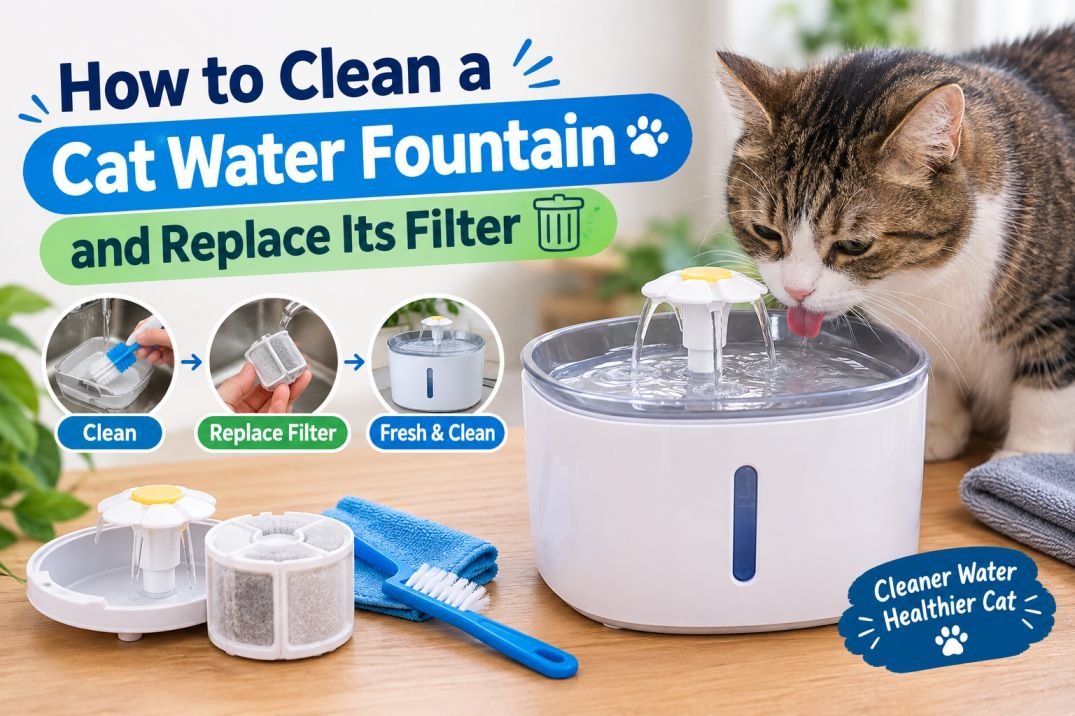
A cat water fountain needs more than a refill and a new filter to stay clean. Hair and debris can collect around the pump, while residue can build up on the reservoir and drinking surface. A simple routine—unplug, take apart, wash, rinse, clean the pump, and replace the filter when due—helps keep the fountain working as intended.
Fountains differ in their materials, filter shapes, and pump designs, so use this guide alongside the instructions for your exact model. In particular, check which parts are dishwasher-safe and how often the manufacturer recommends cleaning the pump.
This post contains affiliate links. As an Amazon Associate, PurrYork Pets earns from qualifying purchases at no extra cost to you. See our Affiliate Disclosure for details.
What You’ll Need
- A clean water bowl to use while the fountain is apart
- Mild dish soap and a soft sponge or cloth
- A small brush for the pump, impeller, tubing, and narrow channels
- A fresh, model-compatible replacement filter
- A clean towel or drying rack
Do not use a dishwasher for the pump, adapter, or any part the manual marks as hand-wash only. Avoid abrasive pads that can scratch plastic or damage a stainless-steel finish.
Quick Cleaning Steps
- Unplug the fountain with dry hands. Move the plug and adapter away from the sink.
- Set out a bowl of fresh water for your cat while you clean.
- Empty and disassemble the fountain according to its manual. Take a photo first if you may forget the order of tubes or covers.
- Remove the filter. Rinse or discard it according to the maker’s instructions. Keep soap away from carbon filters.
- Wash the reservoir and drinking parts with mild dish soap and a soft sponge. Clean seams and channels with a small brush.
- Take apart and clean the pump if the manual allows it. Remove hair and debris around the impeller.
- Rinse every washable part thoroughly so no soap residue remains.
- Install a fresh or properly rinsed filter in the correct direction and position.
- Reassemble and refill to the marked level before reconnecting power.
- Check the flow and listen for unusual noise. If the pump sputters or does not circulate water, unplug it and recheck the water level and assembly.
Step 1: Unplug and Empty the Fountain
Always disconnect a corded fountain from power before taking it apart. Keep the outlet, adapter, and electrical base dry; do not carry a full fountain by its cord. Pour out the old water, then move the fountain parts to a sink or counter where small pump pieces cannot fall down the drain.
Set out a clean bowl of water so your cat has access to a familiar water source while the fountain is being cleaned.
Step 2: Disassemble the Fountain
Remove the lid or tray, filter cover, filter, tubing, and pump in the order described in the manual. Fountain designs differ: some pumps connect to tubing, some attach magnetically to a base, and others sit in a sealed tank assembly. Avoid pulling on wires or forcing clips that do not release easily.
If the parts are hard to remember, take a quick photo before disassembly. Keep rubber seals and small clips together; a missing or misplaced seal can cause leaks or poor water flow.
Step 3: Wash the Reservoir, Tray, and Spout
Use warm water, mild dish soap, and a soft sponge or cloth on the parts the manual says are washable. Brush around corners, seams, and spout openings where slime, fur, or mineral scale can collect. Rinse thoroughly until the parts no longer feel slippery or smell of soap.
Some fountains have dishwasher-safe bowls or trays, while others require hand washing. Even when the bowl is dishwasher-safe, the pump, adapter, and electrical base should stay out of the dishwasher. Check the model manual rather than assuming that similar-looking parts share the same care instructions.
Step 4: Clean the Pump and Impeller
The pump is easy to overlook because much of it sits below the water line. Hair, food particles, and mineral deposits can build up around the impeller and reduce water flow or make the pump noisy.
If your model’s manual permits pump disassembly:
- Open the pump cover as shown in the manual.
- Remove the impeller carefully; it may be held in place by a magnet.
- Rinse the impeller and pump parts with water.
- Use a small brush or cotton swab to clean the impeller well and intake channels.
- Rinse and reassemble the pump, making sure its cover and seals are fitted correctly.
Do not submerge the adapter or electrical base. Use vinegar or another descaling solution only if the manufacturer allows it for your model, and rinse the parts thoroughly afterward. PetSafe’s pump-cleaning instructions, for example, describe using a diluted vinegar solution for hard-water buildup on compatible removable pump parts.[^1]
Step 5: Rinse or Replace the Filter
Find the filter’s shape and model number in the fountain manual before ordering a replacement. Filters that look similar may not fit the same housing. If you are not sure which Dockstream filter matches your unit, see our PETLIBRO Dockstream Replacement Filters (2026): Which Models Are Compatible?.
Many carbon filters need to be soaked or rinsed before installation to remove loose carbon dust. Follow the directions for your brand. Do not wash a disposable carbon filter with soap; soap residue can remain trapped in the filter. PetSafe advises rinsing new Drinkwell 360 charcoal filters until the water runs clear.[^2]
Some fountains also have a foam or mesh pre-filter around the pump. If the manual says it is reusable, rinse it with clean water and replace it when worn or damaged. Do not confuse a reusable pre-filter sponge with a disposable carbon cartridge.
Replace the filter at the interval stated in the manual, or sooner if it is visibly saturated, clogged, or restricting flow. Rinsing a disposable filter does not reset its replacement schedule.
Step 6: Reassemble, Refill, and Test
Return the pump, tubing, filter, cover, and reservoir to their correct positions. Confirm that seals are in place and that the cord is routed through its channel without being pinched. Fill the tank to the minimum or maximum line specified by the manufacturer; running a pump dry can damage it.
Reconnect power only after the fountain is assembled and the pump is covered by enough water. Watch the fountain for a minute to check that water circulates normally and no leaks appear. If it is noisy or flow is weak, unplug it and check for a low water level, a misplaced filter, trapped air, or a pump that needs another cleaning.
For more troubleshooting, see Cat Water Fountain Pump Not Working? Common Causes and Fixes.
How Often Should You Clean a Cat Water Fountain?
Use the schedule in the manual for your exact model, and clean it sooner if you see hair, slime, food, or reduced flow. Manufacturers set different intervals. For example, the Catit Stainless Steel Flower Fountain manual recommends rinsing the fountain and filter every three days and cleaning the pump weekly; PetSafe’s Viva instructions recommend cleaning the fountain every two to four weeks, with more frequent cleaning for multiple-pet homes.[^3][^4]
These examples are not interchangeable schedules. The number of cats, how much hair or food enters the fountain, water hardness, and the pump design can all affect how quickly parts need attention. Check the water level daily and refresh the water when it looks dirty or has debris.
Common Cleaning Mistakes to Avoid
- Leaving the pump plugged in while handling water. Unplug it before disassembly or cleaning.
- Putting the entire unit in the sink or dishwasher. Keep the adapter and electrical base dry; follow the manual for the pump and tray.
- Using soap on a carbon filter. Rinse or replace the filter only as directed.
- Forgetting the impeller. Replacing a filter will not clear hair or scale from inside the pump.
- Using a generic filter without checking the fit. A mismatched filter can block flow or let water bypass the filter.
- Reassembling with too little water. Check the fill line before turning the pump on.
- Using vinegar or descaler on every part. Confirm that the manufacturer approves the product and dilution for your fountain materials.
- Assuming one schedule fits all fountains. Use the directions for your model, and shorten the interval if it becomes dirty sooner.
How Much Do Replacement Filters Cost?
Filter costs vary by brand, pack size, and replacement schedule. The correct filter also depends on the exact fountain model. See our How Much Do Cat Water Fountain Filters Cost? A Brand-by-Brand Guide to compare approximate pack and annual costs.
Frequently Asked Questions
Can I clean a cat fountain filter and reuse it?
Only if the manufacturer identifies that part as reusable. Rinse reusable pump sponges as directed. Disposable carbon cartridges should be replaced on schedule; rinsing them does not restore their filtering capacity.
Can I use vinegar to clean the fountain?
Only where the fountain maker allows it. Some manufacturers recommend diluted vinegar for mineral deposits on removable pump parts; others may specify a different process. Never apply descaler to the electrical base or adapter, and rinse treated parts thoroughly.
Do I need to replace the filter every time I clean the fountain?
Not necessarily. Follow the filter’s stated replacement interval and inspect it during cleaning. Some foam pre-filters can be rinsed and reused, while carbon filters are usually replaced after their service interval or sooner if clogged.
Why is my fountain noisy after cleaning?
The water level may be too low, the pump or impeller may not be seated correctly, or air may be trapped in the pump. Unplug the fountain, check the assembly and fill line, then test it again. For persistent issues, use the troubleshooting steps in our pump guide.
Final Takeaway
Clean the reservoir, drinking surface, filter housing, and pump—not just the parts you can see. Unplug before handling the pump, keep electrical components dry, avoid soap on disposable filters, and follow the schedule for your exact fountain. A clean water bowl can serve as a backup while the fountain is being washed.
Compare fountains in our Best Cat Water Fountains (2026): The Complete Buying Guide, and see Top 5 Best Cat Water Fountains for Multiple Cats (2026) for multi-cat options.
Sources
[1]: PetSafe: How to Clean Your Pet Fountain Pump
[2]: PetSafe: How to Clean the Drinkwell Stainless Multi-Pet Fountain
[3]: Catit Stainless Steel Flower Fountain manual
[4]: PetSafe: How to Disassemble and Clean the Viva Fountain