
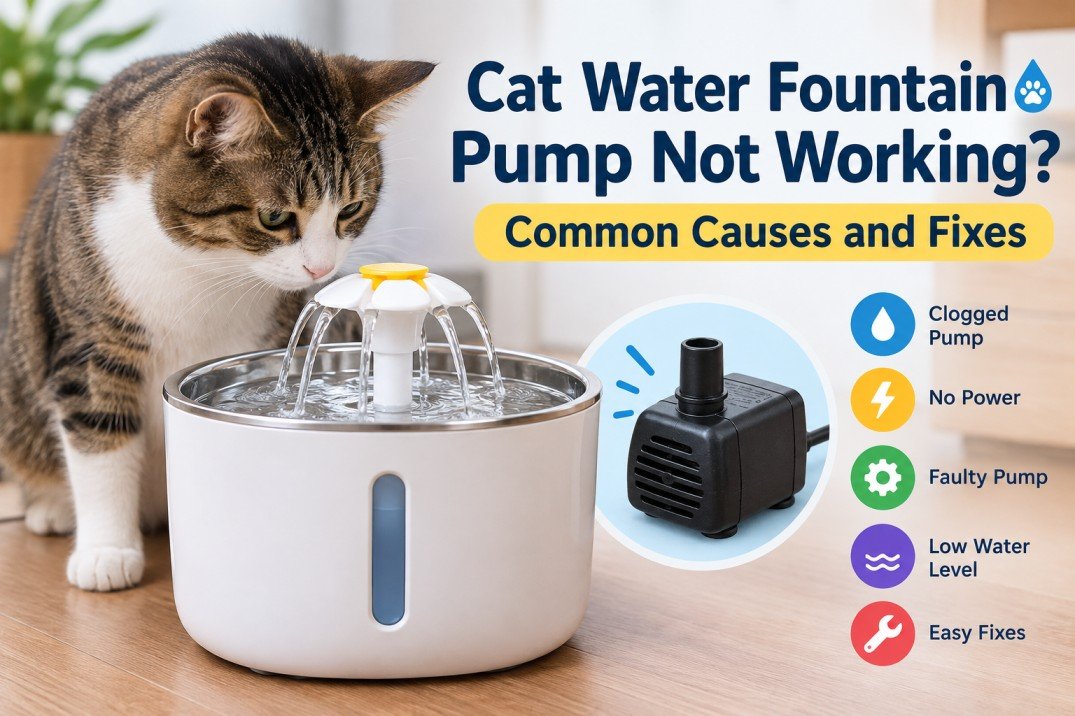
A cat fountain pump that stops, sputters, or barely moves water often has a simple cause: the water is too low, a part is misaligned, or hair and mineral deposits are blocking the impeller. Regular cleaning can restore flow, but every fountain is built differently, so check the manual before taking the pump apart.
This guide walks through safe checks for low or no water flow, unusual pump noise, and a fountain that stops after cleaning. Always unplug a corded fountain before handling the pump or water, and do not let a pump run dry.
This post contains affiliate links. As an Amazon Associate, PurrYork Pets earns from qualifying purchases at no extra cost to you. See our Affiliate Disclosure for details.
Quick Fix Checklist
- Unplug the fountain. Use dry hands and disconnect power before touching water or removing parts.
- Check the water level. Fill to the maker’s recommended line so the pump intake remains covered.
- Check assembly. Make sure the pump, filter, tubing, lid, and spout are seated in the correct order.
- Rinse or replace a clogged filter. Follow the filter instructions; some carbon filters should be rinsed before use, but should not be washed with soap.
- Clean the pump and impeller. Remove hair, slime, and debris using the steps in the specific model’s manual.
- Check the power supply. Inspect the cord and adapter for damage and try a working outlet, if the manual allows.
- Test after reassembly. Refill the fountain before restoring power. If the pump still will not run, stop and contact the manufacturer or replace the pump with the correct part.
Safety Before Troubleshooting
- Unplug a corded fountain with dry hands before disassembly, cleaning, or moving the pump.
- Keep the electrical base, adapter, and plug dry. Do not immerse any part the manual identifies as non-waterproof.
- Never run the pump without enough water. Some fountains shut off automatically at a low level, but many pumps can be damaged by running dry.
- Do not open or repair a sealed power adapter, splice a cord, or use a damaged cable. Replace the approved part or contact the manufacturer.
- Keep tiny pump parts and the impeller away from the sink drain while cleaning.
1. The Water Level Is Too Low
What you may notice: The pump is silent, sputtering, or louder than usual; water flow has weakened; or the fountain has stopped even though a little water remains.
Many pumps need to stay fully submerged. A water level below the intake can pull in air, interrupt circulation, or cause the pump to run dry. Some newer models use a low-water sensor and stop before the reservoir is completely empty. For example, Catit’s PIXI Stainless Steel UV-C model stops its pump when the displayed level reaches its low-water threshold.[^1]
What to do:
- Unplug the unit, then refill to the marked MAX line or the level specified in its manual.
- Check whether the pump is positioned correctly and fully under water.
- Reassemble and restore power only after the pump and reservoir are in place.
- Check the level daily until you know how quickly your cats use the water.
Do not assume the fountain is broken just because there is still water visible; the pump intake or sensor may already be above the usable level.
2. Hair or Debris Is Blocking the Impeller
What you may notice: The pump hums but water barely moves, the flow is intermittent, or the fountain has become louder over time.
Hair, food crumbs, mineral deposits, and biofilm can collect around the pump’s small rotating impeller. Catit says hair or debris can clog a Flower Fountain pump and reduce its power. PetSafe also recommends opening the pump and cleaning around the impeller when a pump stops working.[^2][^3]
What to do:
- Unplug the fountain and remove the pump according to the manual.
- Open only the parts the manual says are user-serviceable. Pump covers and impellers are small and can be delicate.
- Rinse the pump parts and remove hair or debris with a small soft brush or cotton swab.
- Clean the impeller well and its housing. Do not force or bend the impeller shaft.
- Rinse away all residue, reassemble the pump, and reinstall it securely.
Some manufacturers recommend a vinegar solution for mineral scale; others specify a different cleaning method. Use vinegar only if the instructions for your fountain allow it, and rinse everything thoroughly before use.[^3]
3. The Filter Is Clogged, Dry, or Installed Incorrectly
What you may notice: The pump runs, but the stream is weak; water is spilling over the tray; or flow dropped after you installed a new filter.
A filter loaded with fur and debris can restrict water flow. A new filter that has not been soaked or rinsed as directed may also slow the initial flow, and a filter or filter cover fitted the wrong way can block a channel. PETLIBRO notes that its Dockstream filters should be soaked before first use and that an incorrectly positioned filter or assembly can affect output.[^4]
What to do:
- Check the filter’s replacement schedule and inspect it for visible dirt or saturation.
- Rinse or soak it only as directed by its maker. Do not use soap on a filter unless the manufacturer specifically instructs you to.
- Confirm the filter is the correct model and sits flat in its holder.
- Recheck the filter cover, tray, and outlet alignment against the manual.
- Replace a clogged or damaged filter rather than trying to wash and reuse a disposable cartridge.
If the fountain started slowing immediately after a filter change, remove and reinstall the filter carefully. If flow returns without the filter, stop using the fountain until you confirm the replacement is correct and compatible.
4. A Tube, Outlet, or Fountain Part Is Misaligned
What you may notice: The pump sounds normal, but no water comes from the spout; water leaks or overflows; or the fountain stopped after you washed it.
Fountain parts may need to line up precisely. A tube that is not attached, a tray that is not seated, or a filter lid placed out of sequence can interrupt flow. PETLIBRO’s troubleshooting guidance calls out assembly gaps and incorrect component order as causes of poor flow.[^5]
What to do:
- Unplug and drain the fountain.
- Reassemble from the pump upward, following the model’s diagram rather than relying on memory.
- Check the pump outlet, tube, filter housing, tray, and spout for a snug fit.
- Make sure the cord is routed through its channel and is not pinched beneath the base.
- Refill to the required level before turning it on.
If water is escaping from between parts, switch the fountain off and correct the fit before using it again.
5. The Pump Needs to Release Trapped Air
What you may notice: The pump turns on but flow is delayed, bubbling, or inconsistent after a refill, deep clean, or long period in storage.
Air can remain in the pump or tubing after the unit has been emptied. Some models may need a short time to prime once refilled. Do not leave a pump running dry while waiting for flow.
What to do:
- Unplug the fountain and make sure the pump and intake are fully submerged.
- Confirm tubing and pump connections are secure.
- Refill to the recommended level, then restore power.
- Follow any priming steps in the manual. If the model allows it, gently tilt the assembled reservoir to release trapped air, keeping the electrical parts dry.
If the pump continues to run without moving water, switch it off and return to the filter, assembly, and impeller checks.
6. The Outlet, Adapter, or Cord Is the Problem
What you may notice: The pump is completely silent, the indicator light is off, or the fountain works only when the cord is moved.
The issue may be at the power source rather than in the pump. Check only external connections; do not open a power adapter or try to repair a cord.
What to do:
- Check that the plug and connector are fully seated and the outlet switch is on.
- Try a different working outlet, keeping the plug and adapter away from splashes.
- Check the cord and adapter for cuts, kinks, fraying, or heat damage. If damaged, unplug it and stop using it.
- For a rechargeable or battery-powered fountain, check the charge and reconnect the cable as directed by the manual.
- Contact the manufacturer if the adapter or pump may have failed. Use only a compatible replacement part.
7. The Pump Has Worn Out
If the fountain is filled correctly, assembled properly, and the pump is clean, but it still will not move water, the pump may have failed. Pumps are replaceable on many models, but the connector, voltage, and fit must match the fountain. Check the manufacturer’s support page or contact customer service with the fountain’s model number before ordering a replacement.
Do not substitute a pump based only on appearance. An incompatible pump can fail to fit, run at the wrong flow rate, or create an electrical hazard.
Why Is My Cat Fountain Pump Noisy?
A low water level is a common cause of new pump noise because the pump may not be fully submerged. Hair or scale around the impeller can also make it vibrate or strain. A fountain sitting on an uneven or resonant surface may amplify normal pump sounds.
Try these steps:
- Refill to the recommended level.
- Unplug and clean the pump and impeller.
- Check that the pump is attached firmly to the base and that the fountain is on a stable, level floor.
- Confirm that the filter, cover, and tubing are seated correctly.
- If the pump remains noisy after cleaning, contact the manufacturer or check whether the pump is covered by warranty.
How Often Should I Clean the Pump?
Follow your fountain’s manual. As one example, PetSafe recommends cleaning its pump at least monthly and says multi-pet homes may need cleaning every two weeks.[^6] Catit’s Flower Fountain manual advises more frequent pump cleaning and says not to let the pump run dry.[^7] Hair, dust, hard water, and the number of pets can make cleaning necessary sooner.
When you clean the pump, also wash the reservoir and drinking surfaces, rinse away soap, and inspect the filter. A new filter cannot clear debris from the impeller.
When to Stop Troubleshooting
Stop using the fountain and contact the manufacturer if the cord or adapter is damaged, the base has gotten wet, you smell burning, the pump becomes unusually hot, or cleaning and correct reassembly do not restore flow. Keep a clean bowl of fresh water available while the fountain is out of service.
Final Takeaway
Start with water level, assembly, filter placement, and a careful pump cleaning. These checks resolve many common flow problems. Always unplug before handling the pump, protect the electrical base from water, and follow the instructions for your exact model. If the pump still does not work—or any electrical part is damaged—use a compatible manufacturer-approved replacement or contact support.
For step-by-step maintenance, see How to Clean a Cat Water Fountain and Replace Its Filter. Compare replacement costs in How Much Do Cat Water Fountain Filters Cost? A Brand-by-Brand Guide and see our Best Cat Water Fountains (2026): The Complete Buying Guide.
Sources
[1]: Catit: PIXI Stainless Steel UV-C Fountain Q&A
[2]: Catit: Flower Fountain Q&A
[3]: PetSafe Support: Pump not working in Drinkwell Platinum
[4]: PETLIBRO: Dockstream monitoring fountain help
[5]: PETLIBRO: Glacier fountain troubleshooting
[6]: PetSafe: How to clean a pet fountain pump
[7]: Catit Stainless Steel Flower Fountain manual