
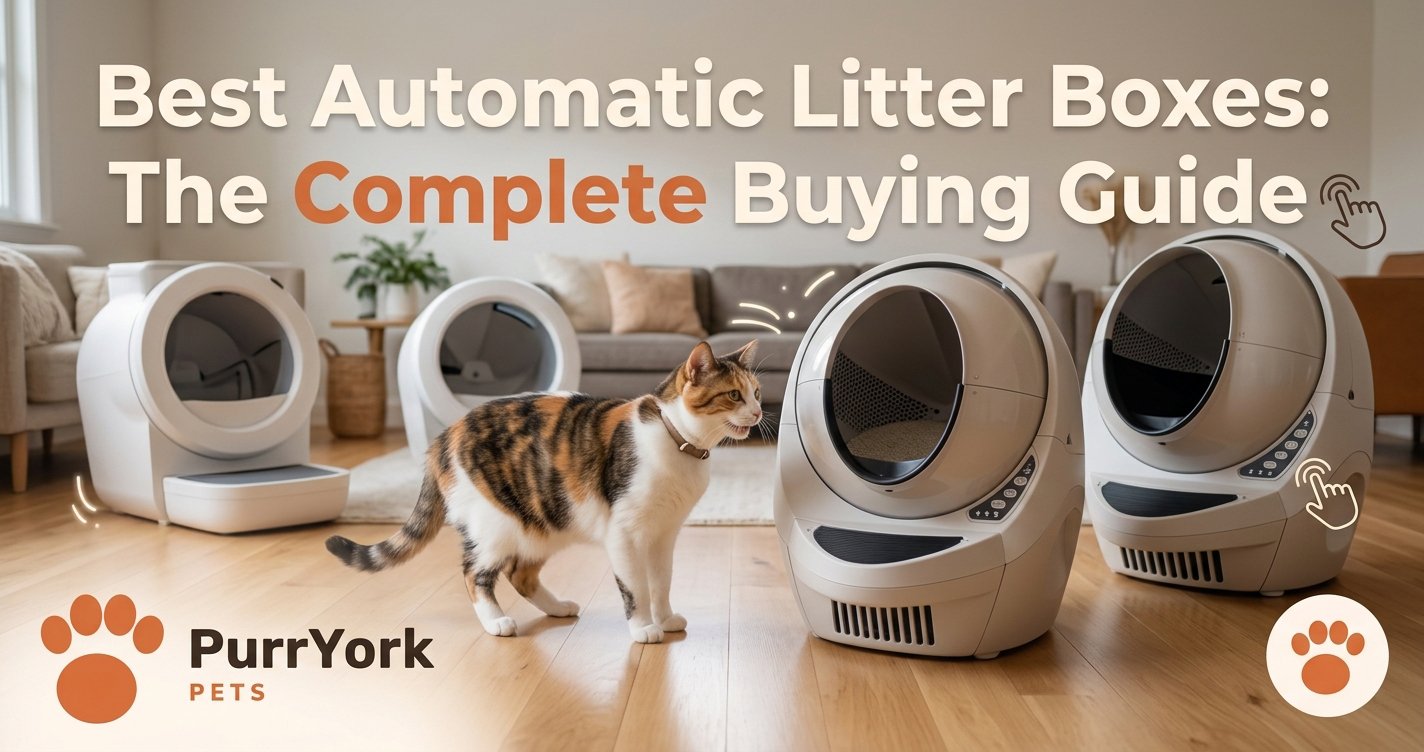
Scooping the litter box is the chore most cat owners like least. An automatic litter box takes over the daily scooping, and some also track your cat’s visits, seal waste away, and cut odor. They are not magic, though. They cost more than a regular box, need regular emptying and cleaning, and some cats take time to accept them.
This guide explains how automatic litter boxes work, who they suit, what to check before you buy, and how to introduce one to your cat. Each section links to a full review of the best options for that need.
This post contains affiliate links. As an Amazon Associate, PurrYork Pets earns from qualifying purchases at no extra cost to you. See our Affiliate Disclosure for details.
Quick Guide: Match Your Home to a Box
- You have more than one cat: try an automatic litter box for multiple cats.
- Your cat is big or heavy: try an automatic litter box for large cats.
- Your cat is nervous or you are a light sleeper: try a quiet automatic litter box.
- You want to spend less: try a budget automatic litter box.
- Smell is your main worry: try an automatic litter box for odor control.
How Automatic Litter Boxes Work
Most automatic boxes sift or rake the litter after your cat leaves, and move the clumps into a waste bin.
Rotating drum or globe boxes turn so that clean litter falls through a screen and clumps stay behind, then drop the clumps into a sealed drawer or bin.
Rake-style boxes drag a comb through the litter and push the waste into a covered compartment.
Tray-based boxes use a disposable tray, often filled with crystal litter, and a rake that moves waste to a covered area. You replace the whole tray periodically.
Most are triggered by sensors and wait a set time after your cat leaves, then run a cycle. Many connect to an app that records visits, and some also track weight.
Are Automatic Litter Boxes Worth It?
They can be, if you do not mind the trade-offs.
What you gain: less daily scooping, a fresher box between cleanings, and in many models, usage tracking that can help you notice a change in your cat’s habits.
What you give up: a higher price, running costs such as liners, bags, filters, deodorizers, or crystal litter, and more parts that can break. Prices run from under $200 for budget models to well over $500 for premium ones.
What does not change: you still need to empty the waste, top up the litter, and clean the box. And some cats simply do not like them.
An app that shows changes in your cat’s visits can be useful, but it is not a diagnosis. If your cat’s bathroom habits change, talk to your vet.
Boxes for Multiple Cats
With several cats, waste builds up fast and cats can disagree about sharing. Look for a large interior, a big waste bin, and ideally a way to tell your cats apart. Bins listed for two weeks are usually rated for one cat, so expect to empty a shared box much more often. It also helps to keep a second box available, since a common guideline is one box per cat plus one extra.
See our full guide to the best automatic litter boxes for multiple cats.
Boxes for Large Cats
Big cats need a roomy interior, a wide opening, and a weight limit well above their weight. Sensors can work less reliably near the limit, so leave a margin. Open-top boxes avoid ceiling and opening limits, while a low entry helps older, heavier cats.
See our full guide to the best automatic litter boxes for large cats.
Quiet Boxes for Sensitive Cats
No automatic box is silent, and reviewers do not agree on exact noise levels. For a nervous cat, a gentle start, a delay before cleaning, and a sleep mode matter as much as raw loudness. Some cats prefer open-top boxes, while others like an enclosed one. Introduce the box slowly, and keep the old one nearby at first.
See our full guide to the best quiet automatic litter boxes for sensitive cats.
Budget Boxes
You do not need to spend $500 to stop scooping, but cheaper boxes often come with shorter warranties, fewer odor control layers, and less proven reliability. Do not skip safety features such as presence-detecting sensors and an anti-pinch design, and add up the running costs before you decide.
See our full guide to the best budget automatic litter boxes.
Boxes for Odor Control
No box removes odor entirely. The better ones remove waste quickly, seal it away in a closed bin or bag, and use filters or deodorizers for what escapes. Those filters and deodorizers cost money to replace, and even a sealed bin needs to be emptied regularly.
See our full guide to the best automatic litter boxes for odor control.
How to Choose an Automatic Litter Box
Start with your cat. Check your cat’s weight against the box’s minimum and maximum, and make sure there is room to turn around. Kittens below the minimum weight should not use the automatic cycle.
Decide between open-top and enclosed. Open-top boxes feel less trapped to many cats and suit big breeds. Enclosed boxes contain more odor and litter, but some cats dislike them.
Check the safety features. Look for sensors that stop the cycle when your cat is inside or nearby, and an anti-pinch design.
Look at the waste handling. A sealed bin, automatic bagging, or a pull-and-wrap system keeps waste contained and cuts contact.
Check your litter. Many boxes only work with clumping litter, and tray-based boxes need crystal litter. Using the wrong type can cause jams.
Add up the running costs. Liners, bags, filters, deodorizer packs, and crystal litter all add to the price over time.
Read the warranty and reviews. Look at the length of the warranty and the quality of customer support. Check recent reviews for sensor or motor problems, and look for recalls or safety notices on the specific model.
Check the app. Many apps need a 2.4 GHz Wi-Fi connection. If you do not want an app, choose a box with physical controls.
How to Introduce an Automatic Litter Box
Most cats accept a new box with a slow introduction.
- Place the new box next to the old one, and leave the old one in place.
- Add some used litter to the new box so it smells familiar.
- Turn off the automatic cycle at first, and let your cat use it like a regular box.
- Switch on the automatic mode once your cat uses it comfortably, ideally with a delay after each visit.
- Watch your cat for the first few cycles, and give treats for using the box.
Keep the old box a little longer if your cat seems unsure. If your cat avoids the new box altogether, talk to your vet to rule out a health cause.
Frequently Asked Questions
Do automatic litter boxes really work? Yes, they take over the daily scooping. You still need to empty the waste, add litter, and clean the box.
Are automatic litter boxes safe for cats? Good models have sensors that stop the cycle when your cat is nearby. Follow the weight limits, watch your cat at first, and avoid models with reports of sensor problems.
How often should I empty the waste? Follow the maker’s guidance, and empty earlier if you have several cats or notice odor. Sealed bins still build up bacteria.
Can kittens use automatic litter boxes? Only if they weigh more than the box’s minimum. Below that, use manual mode or a regular box.
Do I need an app? Not always. Many boxes work without one, but apps add tracking and settings. Check whether the box lets you set key options on the unit itself.
Final Thoughts
The right automatic litter box depends on your cats and your home. Start with what matters most, whether that is size, noise, budget, or smell, then browse the full guide for that need to compare options.
Ready to dive in? Start with our guides to multiple cats, large cats, quiet boxes for sensitive cats, budget boxes, and odor control.