
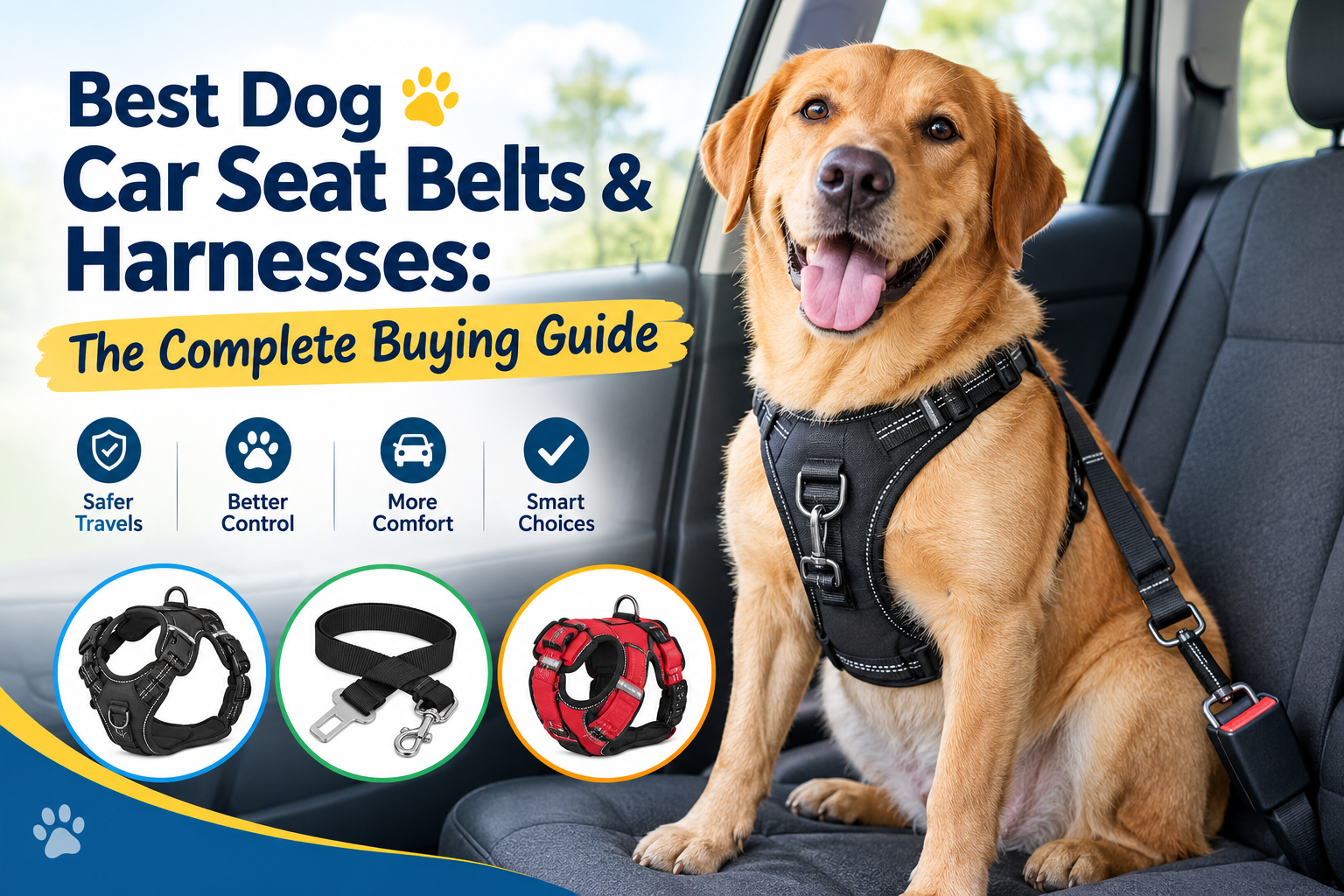
The complete guide to dog car seat belts and harnesses in 2026 — by size, need, vehicle, and budget, with links to our full in-depth reviews.
This post contains affiliate links. As an Amazon Associate, PurrYork Pets earns from qualifying purchases at no extra cost to you. See our Affiliate Disclosure for details.
There’s No Single “Best” Dog Car Harness — Here’s Why
Search “best dog car seat belt” and you’ll find a dozen lists all recommending the same five or six products, as if a 6-lb Chihuahua, a 90-lb Mastiff, and an anxious rescue dog all need the same piece of gear. They don’t. A harness that’s genuinely excellent for a large, calm dog can be the wrong choice for a small dog prone to car sickness, and a budget pick that’s perfectly adequate for a healthy adult dog isn’t sturdy enough for a giant breed generating real force in a hard stop.
This guide is built around that reality. Below you’ll find the fundamentals that apply no matter what dog you have, followed by direct links to our full, in-depth picks for your specific situation — by size, by need, by vehicle, and by budget.
What Actually Matters in Any Dog Car Restraint
Before getting into specific use cases, a few things hold true regardless of your dog’s size or temperament:
- Attach to a harness, never a collar. A collar concentrates all the force of a sudden stop on your dog’s neck. Every restraint on this site connects to a harness.
- “Crash-tested” isn’t a regulated term. There’s no US federal safety standard for pet restraints, which means any brand can print “crash tested” on the box. Look for actual published data — ideally independent testing from the Center for Pet Safety (CPS) — rather than taking the phrase at face value. Our Best Crash-Tested Dog Car Seat Belts (2026) guide breaks down which brands actually publish real results.
- Fit matters more than brand. A well-known harness that’s loose or too tight offers less real protection than a properly fitted budget option. Measure your dog’s chest girth before buying, not just their weight.
- Metal hardware holds up better than plastic under repeated use and sudden load, especially as your dog’s weight increases.
- A short, controlled tether beats a long one. Slack is what lets a dog become a projectile during a hard stop — keep the connection between harness and seat belt as short as comfortably possible.
Choose by Your Dog’s Size
Size changes almost everything about what a harness needs to do well. A harness that fits a Great Dane’s chest and shoulders is a completely different product from one built for a Chihuahua, even if both are technically “adjustable.”
- Small dogs (under 25 lbs): need true small-breed sizing rather than a scaled-down large harness, and often benefit from a booster seat that lets them see out the window. See our full picks in Best Dog Car Seat Belts for Small Dogs (2026).
- Large and giant breeds (60+ lbs): need reinforced hardware and, ideally, crash-test data at their actual weight — many “large dog” harnesses only test up to 75 lbs. See Best Dog Car Seat Belts for Large Dogs (2026).
Choose by Your Dog’s Needs
Beyond size, your dog’s temperament and health can matter more than anything else on this list.
- Senior dogs often deal with arthritis, reduced mobility, and thinning skin, which changes what’s comfortable and practical day to day — easy-clip buckles and padded chest panels matter more than they do for a younger dog. See Best Dog Car Seat Belts for Senior Dogs (2026).
- Dogs prone to car sickness benefit from setups that minimize swaying and, where possible, let them see out the window to reduce the sensory mismatch that contributes to nausea. See Best Dog Car Harnesses for Car Sickness (2026).
- Dogs with car anxiety need a secure, snug-fitting setup that reduces the sense of instability that often drives anxious behavior, sometimes paired with calming aids. See Best Dog Car Harnesses for Dogs with Car Anxiety (2026).
Choose by Your Vehicle
Not every harness or seat belt system works equally well in every vehicle. SUVs and trucks in particular come with different seat heights, cargo configurations, and anchor point placement than a standard sedan, which changes which restraint styles actually make sense. See our picks in Best Dog Car Seat Belts for SUVs and Trucks (2026).
Choose by Budget
Price and safety aren’t perfectly correlated in this category — some of the most expensive harnesses are premium versions of features you may not need, while some genuinely well-built options cost very little. Two of our guides approach the category from opposite ends of that spectrum:
- If cost is your main constraint, see Best Budget Dog Car Seat Belts (2026) for options that don’t cut corners on the fundamentals.
- If independently documented crash protection is your top priority regardless of price, see Best Crash-Tested Dog Car Seat Belts (2026).
Frequently Asked Questions
Is a dog car harness actually necessary, or is it just for comfort? An unrestrained dog can become a serious hazard in a collision — both to itself and to human passengers — and can also be a driving distraction well before any accident happens. A properly fitted harness connected to the seat belt addresses both issues.
What’s the difference between a dog seat belt and a dog car harness? “Harness” refers to the piece worn on the dog’s body; “seat belt” or “tether” refers to the strap connecting that harness to the vehicle’s existing seat belt system or anchor points. Most products in this category include both, but they’re sometimes sold separately, and a good tether matters as much as a good harness.
How do I know if a harness actually fits my dog? Measure your dog’s chest girth (the widest part of the ribcage, just behind the front legs) rather than relying on weight alone — two dogs of the same weight can have very different chest sizes. You should be able to fit two fingers flat between the harness and your dog’s body.
Do I need a different harness for every trip type, or one that does everything? Most dogs do fine with one well-chosen harness that fits their size and needs. The guides on this page are meant to help you identify the single best option for your specific dog, not to suggest you need several.
Are booster seats safer than harnesses for small dogs? For most small dogs, a crash-tested harness connected to the seat belt provides more secure restraint than a booster seat alone during a collision. Boosters are primarily a comfort and visibility upgrade — many pair a booster with a harness and short tether rather than using one in place of the other.
Explore Our Full Guides
Each of the guides below goes deep on one specific situation, with detailed picks, pricing, and pros and cons for that use case:
- Best Dog Car Seat Belts for Small Dogs (2026)
- Best Dog Car Seat Belts for Large Dogs (2026)
- Best Dog Car Seat Belts for Senior Dogs (2026)
- Best Dog Car Harnesses for Car Sickness (2026)
- Best Dog Car Harnesses for Dogs with Car Anxiety (2026)
- Best Dog Car Seat Belts for SUVs and Trucks (2026)
- Best Crash-Tested Dog Car Seat Belts (2026)
- Best Budget Dog Car Seat Belts (2026)
Note on pricing: Prices referenced across these guides reflect approximate ranges at time of writing and may vary. Check the current listing for exact pricing.